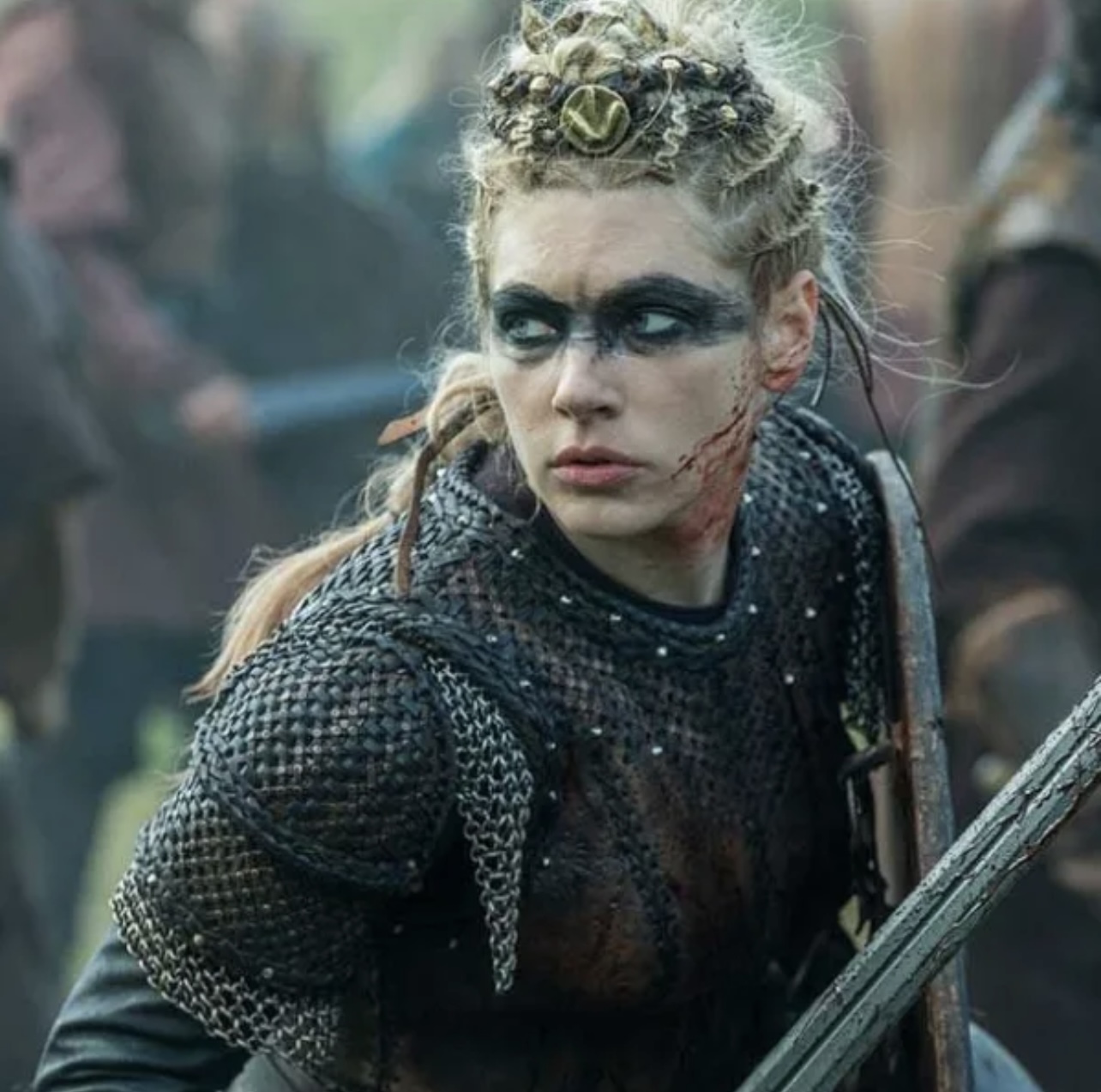
Lagertha Sheildmaiden, beloved of the Gods (above).
Sunday morning is so quiet here, shops are closed, even the local cafe is closed. However, the sun is out, so I’m off to the nearest beach, Hellvik.
I guess it’s time for some history. People associate Norway with Vikings, but what we call Vikings included people from Denmark, and Sweden too. (see above for more info on Vikings). Viking was a term in Norse to mean to, ‘go on a raid.’ The English called them Northmen, and Nor, meaning North. The trade route to the North was called, the North Way, hence the country is called, Norway. You might recognise that Norway is similar to Norman, and Normandy. King Charles the Simple, yep that’s his name, King of France gave Rollo, a leader of a Northman army, the land at the end of the Seine river after a great Viking raid on Paris. The deal with Rollo was to stop the other Viking groups from raiding Paris by making him a Duke of this land. The French called the Northman, Norman, and the plural is Normandy. Hence, you get the Dukedom of Normandy. If your English you will know about William the Conqueror, Duke of Normandy, also known as, ‘William the bastard.’ (he was a bastard child). Well, Rollo, was Williams great-great-great grandfather. Watch historian, Dan Snow’s program to learn more. He also has some great English Castle walks and you will see the Normans met significant resistance, hence all the castles, and he talks to some of the Norman families still literally, ‘holding down the fort.’
King William the conqueror, built Windsor Castle (where Harry got married), the Tower of London, and many of the great castles of England, and most of the English aristocracy are descendants including the Royal family (although mostly German) of the Normans, or Northmen. As the new Norman aristocracy were culturally, ethnically, and linguistically different (they spoke French) from the Anglo-Saxon population they conquered, therefore the origins of the English class system was set in stone.
Anyway, I spent a nice day at the beach. The water temperature is perfect, and not cold like you would think, because the Gulf Stream brings the warm water up here. The beach has little pebbles, crushed shell, and is not that comfortable. Although, its not as bad as, say, Brighton Beach in the UK, where you need a sun lounge.
All those stories about Norway being expensive are true for tourists. I've talked about the alcohol prices, but the groceries are expensive too, with a 25% tax (like a GST). So, I'm spending more money than a budgeted, but Norway is beautiful, and worth it. I guess if you were paid in Norwegian Krones it might not be so expensive.
However, alcohol is still expensive for Norwegians, so I've read they take a drive to Germany through Denmark and load up. Germany does have much cheaper groceries (and alcohol) through discount grocers like Aldi, and Lidl.
Travel tip 1: Save money like a Norwegian and buy your alcohol and groceries in Germany, where its substantially cheaper.
Travel tip 2: Accomodation through AirBnB is not that expensive, however book ahead, because the better value accomodation gets taken early.
Thats a mistake I made, because I was going to Bergen, on the West coast, but decided to stay here, and enjoy the 30 + temperature at the beach, when I went to book I had to pay more than I could have by booking earlier.
In conclusion, Norway requires a little more planning and preparation if you want to save money, as it is an expensive country for foreigners.
Another 30 degree celsius day, so I'm off to Helvikk beach (pictured above) - I know what your thinking - not much of a beach by Australian standards, but I’ll take it on a sunny day. The beach on the rights seems to be for families and the left hand side beach I guess is the adult beach. As it is the only thing that passes for a beach in this area it was quite packed.
There's a lovely coastal walk, and a network of paths up to Flaskebekk if your staying up there, like me. You will probably need Google Maps to navigate your way, but its nicer than walking along the road. There is this concept of a 'right of access' to the water in Nordic countries, so I think this is why there are so many paths in this area.
This is Ursvik, next door to Hellvik, and in the far distance across the water is the city of Oslo. A city of two million people, but you could be a world away on this peninsula.
The sunny weather continues, one of the hottest summers in the Nordic countries for decades. I was talking to my host here who said its becoming a problem for the farmers now as there is no hay for the animals. So, they desperately need some rain.
In the map above you can see where I am in relation to Oslo city. I'm staying closer to Flaskebekk next to a forest, on the ridge near the Oslo fyord. On the left is the Oslo fyord, the main channel to the sea. I arrived from the ferry that leaves Aker Brygge.
Yes its true, a beer in Norway costs 10 Euros or $15 AUD! I know un-Australian. There would be riots in the streets in Australia if we had to pay that price. For comparison a beer costs $4.30 AUD at the Burwood RSL in Sydney.
There is a gorgeous little path down to the water from the house I'm staying.
The Oslo Fyord at the bottom of the trail. It only takes five minutes to get to the water.
Norwegian houses are usually made out of wood, and are painted different colours. This cute one caught my eye (see above). I really like Norwegian style, the houses are beautiful, but in that Scandinavian minimalist style. This is a beautiful part of the world to live in, well, at least, in this glorious Northern European summer.
The sunsets are really amazing up here, around 10.30pm! The view from the porch (see above). As you can see I'm having a really good holiday up here in Northern Europe.
Its about six and a half hours from Oslo to Stockholm by fast train.
My host turned his nose up when I said I was going to Oslo. Well, Oslo has some social problems apparently. Actually I'm not staying in Oslo, but in Nesodden, which is on the long peninsula across the harbour along the Oslo fyord. Apparently, this is where the creative types live in their holiday homes along the water. There are beaches, nature trails, so I can take advantage of this long hot Northern summer.
The plan after that is to take the train from Oslo to Bergen, on the west coast,which is one of the great railway journeys of the world. This is where all those gorgeous pictures of fyords surrounded by mountains are taken. This is where my host said is the best part of Norway.
There is a trap for young players in catching trains in Stockholm. Now, you would expect trains to leave for other countries from Stockholm Central Station, but not necessarily. In my case the trains to Oslo are running from Flemingsberg, a station out in the suburbs reached by the commuter train. There is a bit of disruption in the commuter network at the moment, and the trains are overcrowded from all the immigration, so the infrastructure is struggling, similar to Sydney's overcrowded infrastructure. In this heat, and with the social problems, you can see people are pissed off. It looks like Swedish exceptionalism is over according to the polls for the September election.
Personally, I think Finland have the right economic model - focusing on technology, FinnTech, going down the highly skilled/educated workforce route that increases productivity. Productivity after all is everything. The quality of life is better.
I'm impressed with the comfortable seats, free WiFi, and the little side table with garbage bag onboard. It should be a good trip.
I arrived in Oslo central station on time at 7.45pm. The ferries depart from a place called Aker Brygae. It’s best to catch a bus there. You have to look on the board, find a ferry number, but remember even if it says B10 to Nesoddtangen it can depart from wharf C (see picture). They seem to depart every half hour. A Zone 2 ticket will cover it, which cost 57 NEK. I think it stands for a Norwegian Krone (Crown).
Oslo harbour looks great, downtown Oslo not so much. The German travel guide, Dumont, called it, “The crime capital of Scandinavia', and not safe for females. There have been spikes in sexual assault, with immigrants from Africa and the Middle East found by Oslo police to be overrepresented as perpetrators. Who would have thought?
On that point, I did see something I've never seen before at supermarket checkout in Berlin (see above) - a personal alarm, commonly called a, 'rape alarm.'
So, there is definitely fear in Germany, at least, because checkouts are where you stock high selling items.
Anyway, my AirBnB host is a real viking, with red hair! I'm right near the forest, and a five minute walk to the water. I'm going to take advantage of this warm weather and go swimming - get out in this gorgeous nature.
Perfect weather again - 30 degrees and sunny. My AirBnB host was brilliant, and let me drop my backpack off early, so I was free to explore. Apparently, according to my host this is the warmest summer since 1992!
Sodermalm, just South of the Old City, is a great place to stay. Its a young, trendy area, and you can tell by the quality of the restaurants, cafes, and bars. (Ramen noodles were fantastic - see above).
This is the Teatern, or Theatre in English, a concept by a famous Swedish chef, which is fast food done in a more classy way. You sit on these tables like in a theatre, hence the name. For the first time on the trip I had some Asian food - I was absolutely craving some spice. The Raman noodle place is popular and excellent - top quality. They make it and cook it fresh. I'm a big fan of this concept. Fast food, done well.
One interesting thing they have in Sweden and Finland is that all hard liquor (spirits, high alcohol beer etc) is sold from a State owned shop that has a monopoly on this business. Alcohol is therefore relatively expensive. My host said that this was due to the Russian influence (Russians are all alcoholics), and Sweden had a problem with alcohol. To address the alcohol related illnesses, deaths on the road, and people passing out drunk and dying in the cold, the State stepped in. In Norway I've heard alcohol is even more expensive. I noted the enthusiasm Nordic people were buying alcohol in the duty free shops on the ferry. Personally, I refuse to pay $10 or more for a beer, so the alcohol policy has worked on me at least in Sweden. I'm sure I'll be healthier, wealthier, and all the better for it.
Travel Tip: Remember, the limit is .02 not .05 in Australia.
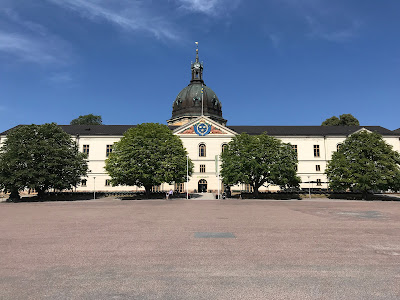
The Armemuseum (Army Museum) is in Ostermalm, and its a former artillery depot. This is actually a really good museum, and its absolutely free! During the period of the Gunpowder Revolution, and particularly, the Thirty Years War (1618-1648) - primarily Roman Catholics versus Protestants, Sweden was really good at warfare. They made a quantum leap in the game with the arrival of this Swedish King.
Gustav Adolphus who is credited for the founding of Sweden as a great power. He did a number of important military reforms.
Prior to Adolphus, Spain was the greatest land power in Europe. through a massive infantry formation called a Tercio, about 3,000 men strong. They basically composed of pikemen and musketeers, and this great mass usually rolled right over rival countries armies.
The musket of the period, looked like this, but with a long cordlike match, and took about a minute or more to reload. The type above are the more expensive wheel lock muskets. Surprisingly, most soldiers actually preferred the cheaper matchlock musket, because it works nearly all the time - i.e. it has less misfires than the more complicated mechanism. To sum up, the great mass of Spanish pikemen would probably crush you by the time you reloaded your musket, so somebody needed to improve the firepower of a formation to defeat the Spanish.
This is what Gustav Adolphus came up with - a three pounder gun that was far lighter and manoeuvrable on the battlefield than the much larger caliber guns that usually remained static. I was very excited to see a real Swedish three pounder gun for the first time. Note the hook in the trail - you can put a long bar through it, and the gunners can push or pull it around or it can be drawn by a couple of horses - cutting edge at the time.
Note: I was in an artillery unit as a gunner in the Australian Army Reserve, and am a trained historian, so I find this exciting!
It fires a three pound ball like this. Now, remember those huge Spanish formations up to 12 ranks ranks deep. On hard ground these balls will bounce along the ground like a bowling ball and bowl soldiers down like skittles - taking off legs in the process. Incidentally, this was why Napoleon, a former artillery officer, waited so long before attacking at Waterloo - he was waiting for the ground to dry out to achieve this effect.
Furthermore, a three pounder gun, can fire canister shot like this, 24 musket balls, in a canister (although this is for a much larger 18 pounder gun, but you get the idea). Basically, its like a giant shotgun.
But the real secret was the rate of fire - you can fire a 3 pounder gun up to 8 times a minute, because Sweden used prepared rounds with the gunpowder and the ball/s fixed together. So, the gunner, once the gun was loaded, just touched a match and the gun would fire.
In conclusion, Gustav, by inventing modern field artillery, greatly improved the firepower of Sweden's armies on the battlefield.
Gustav also improved the cavalry, by training them to charge boot to boot with the sword instead of using a complicated manoeuvre of firing pistols and wheeling away. This way he used the speed and power of the horse and rider to create what the military called, 'shock.' This particularly effective when you have ripped a giant hole in the infantry formation and can ride into it slashing with the sword, and of course the horse will be bucking and kicking out.
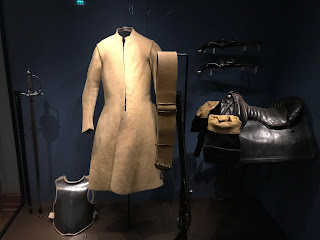
Other Protestant armies, particularly Oliver Cromwell's Ironside cavalry in the English Civil War would use this Swedish tactic, and similar equipment (see above).
The infantry were trained to fire at a higher rate, and in a Swedish volley, three people firing at once - one kneeling, one crouching, one standing. The English were fond of this tactic, and went on to use it regularly.
Combine it all together - artillery, cavalry, and infantry - then you get 'Combined Arms' warfare and that was what Gustav Adolphus invented. We still use combined arms warfare today in the military. You might wonder why this matters, well, it matters, because The Treaty of Westphalia signed in 1648 created the modern state system that we live under today, and it is why Northern Europe is Protestant and Southern Europe is Roman Catholic. The treaty signed meant largely the end of the Wars of Religion in Europe. The Thirty Years Wars killed about 5 million people, and about a third of the German population.
Its also one reason why the West finds Islamic terror attacks so shocking, because the West hasn't had a war of religion for over 350 years!
Some say Europe are starting to understand what that means, historically, they are very bloody, and hard to stop.
........................
On the train back to Sodermalm there was a paralytic drunk man lying in the doorway with what looked like vomit down his beard, mumbling incoherently. I don't know if the State owned monopoly of alcohol is working, particularly when there were drunks in the park too. It must have been far worse before they restricted alcohol. Most people only drink on the weekends, and then they have a habit of binge drinking.
I went back to the Theatre for some more delicious Ramen noodles for dinner. I stocked up on some snacks for the railway journey from the local supermarket.
Anyway, tomorrow I'm catching the train to Oslo. Actually, I'm taking a ferry to Nesoddtangen, across the harbour, which is a much nicer area.
Further information:
Arme' museum website - www.armemuseum.se
Max Boot. War made New
Keith Roberts. Cromwell's War Machine: The New Model Army 1645-1660
Alec Ryrie. Protestants: The Faith That Made the Modern World
Piers, Platt. From the Arquebus to the Breechloader: How Firearms Transformed Early Infantry Tactics
Want to learn more about, The Thirty Years War, then watch the video above.
Suomi sub machine gun (see above) - this is the Finnish gun I was talking about the other day that they have in the Swedish Army Museum. Note the longer barrel than you normally find on these type of weapons that makes it more accurate at longer ranges and the 71 round drum magazine. A quality weapon, expensive to manufacture, but a highly desirable combat weapon in WW2.
A beautiful sunny day in Stockholm, Sweden. I'm going to head out today, and have a look around the old town. I'm staying in Ostermalm, which is not far from Stockholm university, one of the largest in Europe, so the area where I am is full of students.
Catching the train is fairly easy. There are 24 hour or 72 hour tickets that you load onto a blue plastic travel pass that you have to buy but lasts 10 years. The 72 hour pass was about $40 AUD. At most of the stations you don't have to tap it, but just walk through the barriers and they should pick it up. This is much faster without the traffic bank up you experience in Sydney.
Now, the all important McDonalds test. They have sweet potato fries instead of the normal potato fries, which are okay. This is the double truffle burger that was interesting. In Sweden apparently you have to pay to use the bathroom, and this includes McDonalds, which I haven't seen before. There is a sales tax, and that makes it more expensive than Australia. Interestingly, in these Nordic countries its the consumers who are taxed hard with sales taxes (VAT or GST) up to 24%, and the top rate of tax for example in Finland is 60%. Everybody I have spoken to don't mind paying these quite high taxes in exchange for free health, education and a quite broad safety net. However, company tax is only around 20%, much lower than in Australia.
Johan Norbert explains some of the myths and misperceptions about the Swedish utopia. He says it not a case of taxing the rich, but heavily taxing the middle class and the poor (and tourists like me) through high consumption taxes.
I went shopping at the Galleria shopping mall downtime, and was just about to enter when Swedish police were wrestling this slim young man outside before arresting him against the car (note he is entitled to the presumption of innocence).
There are all these conflicting stories about crime in Sweden, particularly immigrants and crime. Headlines about Malmo being, 'The Rape Capital of Europe', and no go areas, even for police.
Even President Trump has commented about crime and immigration in Sweden. This is one commentators view backed up by some statistics (view above).
Personally, I don't feel unsafe, and I think you should critically review all the evidence (from politically left and right sources), and make up your own mind.
Travel tip: There are really nice free washrooms in the Galleria with their own washroom attendant!
Anyway, the old town is very cute.
Lots of narrow streets they had in the Middle Ages.
There are plenty of tourist traps, I mean shops, and restaurants in this area.
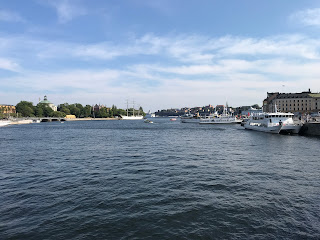
Stockholm is built on a series of islands connected by bridges.
There are deep harbours for the big ferries and cruise ships to get in. Around this area there are lots of museums, historical buildings, and tourist stuff to do. Actually, there are lots of tourists, a shock to my system, after my laid back lifestyle in Finland.
My train to Oslo is on Thursday, so tomorrow, I'm moving to the trendy Sodermalm district to the South of the old town just for one night.
I'm hoping to check out the Swedish Army Museum. Believe it or not, Sweden once was quite good at warfare, before staying neutral (or collaborating with Germany in the World Wars depending on your opinion). I've heard some say that Sweden now can be neutral, because it hides behind Finland, but perhaps that is unfair :)
It was another bright beautiful day in Turku, Finland when I arrived at the port in time for the 0815 Silja Galaxy ferry to Stockholm. This should get me to Stockholm around 7pm. The deck class ticket is only 17 Euros, which I ordered online.
When you arrive you can go to the self service kiosk and scan the QR code to print your boarding pass. Then just go upstairs, and wait for the ferry to board.
These ferries have numerous restaurants, duty free stores, bars, and even nightclubs. You can pay more, and get your own cabin, which is particularly good if your on the night ferry.
I’m a big fan of the all you can eat buffet on level 7, which includes beer, coffee, and dessert. I must admit I did get more than my money’s worth, and at the end I wished I upgraded to a cabin to have an afternoon nap.
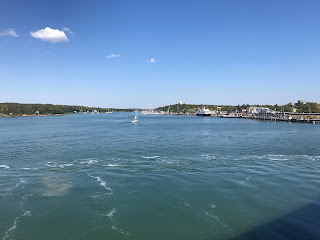
After lunch we arrive at the port of Mariehamn, the capital of Aland. This is an autonomous territory under Finnish sovereignty, which speak Finnish. Its about halfway between Finland and Sweden. Some people get on and off, but the majority stay on to continue to Stockholm.
The last part of the journey involves following the Swedish coastline down to Stockholm. Some of the Mokki’s are a bit more elaborate. Sweden’s economy, and population is about double the size of Finland. Also Sweden has gone down the high immigration route to boost economic growth with about a quarter of its residents born overseas. There have been some social problems as you have probably read about in parts of Stockholm, and especially in Malmo.
I had plenty of time to use the free WiFi onboard to plan the next stage of my travels. After two nights in Stockholm I will be catching the train to Oslo then a ferry to Nesoddtangen in the Oslo Fjord for three nights. All accomodation with AirBnB. I'll say it again you really don't need to pay a travel agent or plan your holidays down to the last detail. All you need is a smartphone or a laptop, and you can do it literally on the fly, anywhere in the world. AirBnB has dramatically dropped the cost of accomodation, and expanded the supply of places to stay.
I am staying in student accomodation about fifteen minutes walk from the ferry terminal. However, its only three train stations from the centre of town.
Tomorrow, I'll head down to the old town, and see the main sites.