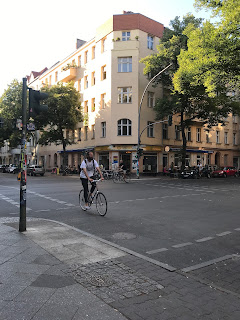
Living in Berlin is relatively cheap compared to the rest of Europe, and it has attracted creative people, and now increasingly new small businesses - a startup culture is developing. In the cafes I overheard a number of people discussing new businesses, film projects, and other creative endeavours. Google has recently moved to Berlin, and tech companies are funding some of these new startups. It’s a very exciting time, and it may in the future address some of Germany’s problems I have identified in this blog like poor information technology, and poor customer service. Germany succeeded brilliantly in the Second Industrial Revolution, but has struggled in the Third (Digital economy) with no companies like Microsoft, Apple, Google, Uber, AirBnB (which I booked my accomodation with), Instagram or Tesla.
I took the U7 to Jacob-Kaiser Platz station, and it was only a short bus ride to Berlin Tegel airport. My next stop will be Helsinki.
My first view of Finland or, ‘the country of a thousand lakes.’ It’s beautiful - very green, lots of forests and of course, lakes.
Helsinki is less than two hours from Berlin, and as Finland is in the EU passport agreement area there is no need to clear customs. They also use the Euro as their currency.
I’m staying in Turku, which is about two hours from Helsinki on the South West coast in an area known as, ‘Finland Proper.’ Turku was for centuries the capital of Finland.
Nearly every Finnish home has a sauna, even in the cottages in the countryside that many have as second homes. This is the one in the house I am staying at. The sauna is perhaps Finland’s most famous export.
Well, the sauna, and the Nokia phone, back before the Apple Iphone took over the market.
In Germany most of the stores are closed, it’s a designated rest day. It’s good that workers get a day off to spend with their families and friends. Tough if your a tourist.
Its quite eerie walking along the quiet streets - I think everybody sleeps in, because more people emerge after 10am. I did manage to find a cafe open in my neighbourhood for my coffee fix.
The beggars were out working/begging on a Sunday. I forgot to mention about the beggars in Berlin - they walk around usually with a small takeaway coffee cup asking for money. Two came yesterday through the cafe, always at least one comes through the train, and you will usually be approached at least once a day, whilst your here. They are not the usual Roma or gypsies you see around tourist sites in Europe.
Having said that I am living in Neukolln, which is on the eastern side of Berlin. Apparently, the more affluent suburbs are on the western side, because the prevailing winds are from the west and blow the bad smells that way!
In any case, I've read the old money lives in the green leafy suburbs of Dahlem, Zehlendorf and Kleinmachnow towards Potsdam, which is where Sun Soucci is, the old palace of the Prussian kings.
If you were alive during the Cold War you will definitely recognise Checkpoint Charlie at the border of West Berlin and East Berlin.
This is the Memorial to the Murdered Jews of Europe located near the Brandenburg gate, so they may never be forgotten. There are still Holocaust deniers in the world, so this memorial is a permanent reminder about the murder of 6 million Jews during WW2.
One can't but feel emotional walking between the concrete pillars representing all the dead. Please don't sit or recline on top of the pillars as I saw some people do as its highly disrespectful.
Nearby is the Bundestag, the old Reichstag, or the German parliament. This is where the big decisions concerning Germany, which affect of course Europe as a whole.
The above video footage was taken by an allied plane after the Battle of Berlin in 1945. That's the Tiergarten its flying over at the start, and you will no doubt recognise the Brandenburg gate. The main road is the Unter Den Linden. Something to keep in mind as we begin today’s walk.
Berlin has an excellent public transport system, and you will no doubt end up at the Alexanderplatz, as it is a transport hub, and a shopping district with the major department stores. You can't miss it, because it has this weird looking tower.
Its a convenient place to start a walk as the Brandenburg gate is about an half hour walk, and you will visit many of the main sites on the way.
This area of Germany is mainly Protestant, because Prussia was the first country to break away from the Roman Catholic Church. Berlin was the capital of the Kingdom of Prussia, and it was the Prussians who united Germany, which was then an assorted variety of principalities. Prussians were fiercely Protestant, and Bismarck (who finally united all the States into Germany) waged a Kulturekampf (Culture War) against the Catholic church dramatically reducing its influence. You might find that a strange thing to do when half of Germany is Roman Catholic, but Bismark didn't want unification so much, as he wanted to impose Prussian authority and values onto the newly formed country. He succeeded - Prussian Virtues have heavily influenced German culture. What outsiders stereotype as typically German characteristics like efficiency, austerity, and discipline are Prussian Virtues. Its a mix of the ethical code of the Prussian army, and Lutheranism and Calvinism.
The first stop on the walk is St.Marienkirche.
You will probably recognise it as a Protestant church from the interior.
If you don't the statue of the famous German, Martin Luther, who began the Protestant movement in 1517, will give it away. If you don't know history, the impact of Protestantism on Northern Europe, and the world, won't feel significant.
"The attractions of loosening the tie with Rome, keeping the money in-house, controlling one's own church, and parcelling up all that ecclesiastical land were as obvious to the German princes as Henry the 8th of England."
Prussia (1525), and England (1534) were some of the first countries to break way from Rome, but most of Northern Europe including Scandinavia eventually followed.
The next stop is the Berlin Cathedral. The city's Protestant cathedral and the burial place of the Prussian Kings (the Kaisers).
The Chancellor, Angela Merkel, is a devout Lutheran, who publicly stated that Germany suffers not from "too much Islam" but "too little Christianity." Nobody really knows why she made the decision to accept millions of refugees to Europe, whether it is to boost the economy to address Germany and Europe as a whole declining population (in Australia migrants contribute half our economic growth of 3% - one of the highest in the OECD), or to address Germany's war guilt, but perhaps she was acting out of her deep Christian faith to help the poor and unfortunate.
This is the Unter Den Linden (under the Linden trees), the main boulevard to the Brandenburg gate, which the plane in the video flew over.
The statue of Frederick the Great, a King of Prussia, sits proudly in the boulevard.
You probably can easily recognise the Brandenburg Gate from television footage of major news events in Europe. Much of the 20th Century was about trying to stop German hegemony over Europe, and which ideology would dominate.
Now, in 2018 the big decisions are still getting decided in Berlin, as Angela Merkel fights for her political survival, based largely on her decision to allow millions of migrants into Europe, and the real problems in integrating them.
I think Berlin will continue making history, and the big decisions concerning Europe will still be made here. Remarkably, as early as 1942, key industrialists and economists, realising the war was lost, were already planning Europe's future, because they knew the allies would need Germany to run Europe.
I had a great coffee from this piece of hipster heaven in my street, Weserstraße. Frequented by alternative types, the same people who frequent the Sydney suburb of Newtown. The bikes out the front were a good sign that there would be good coffee. Also the sign stating, ‘No Borders, no country’, a movement that promotes refugee rights in Europe, was obvious. I was just there for the coffee. In Berlin, you can’t escape politics it seems.
The migrant issue is the number one political issue at the moment in Europe. The situation is that without migrants, Europe’s population, and hence economic growth will plummet, when many European economies are already struggling. Although it’s ironic that the political left in Germany, like most of the people who no doubt frequent this cafe, support increased immigrant, which would help boost consumer demand in Europe, and thus overwhelmingly help capitalism. Immigration is an easy way for countries to boost demand without doing the hard work of improving productivity or competitiveness. Europe’s industry struggles to compete in the Digital Revolution (there is just one European digital company in the world top 40), and these are the businesses of the future. I think after all the political debate (Europeans politicians are masters at this) they will accept vastly increased immigration as the easiest economic option out of their serious economic situation. My prediction is that the immigration policy will eventually look very much like Australia's - a skilled migration point system, detention centres, boat turn backs in the Mediterranean, and the prosecution of people smugglers. Increased migration in an orderly way in other words to save capitalism.
Anyway, I’m off to the Tiergarten as it’s a sunny day. I will try and continue to blog as I go along rather than try and write it all up at the end of the day.
The Tiergarten is a massive park that begins at the end of the Brandenburg gate, and extends for miles. It used to be a hunting ground for Prussian aristocracy.
It provides an escape from city life for the residents, and its easy to find a part for some peace and quiet. As the park is so large you need to work out, which train station to get off at. For example if you want to go to the Berlin Zoo, you will need to get off at Zoologischer Garten, which is at the South West corner of the park.
German customer service?
Now, I don't think it is a surprise that German's are notorious for their bad customer service at least according to Anglo-sphere standards, and especially America. Followers from my six weeks in the US I experienced brilliant customer service, and I often buy American products online from America, and they have never made a mistake. Customer service at Apple Australia is outstanding. In my opinion, Germany is letting it self down as they make world class products, but they let themselves down and lose sales due to their substandard customer service. For example Volkswagen Australia has a bad reputation for After Sales service, so lose sales to Toyota and Honda who are excellent at it, despite Volkswagens making arguably the best cars in each class. Furthermore can you name a German tech company?
If you need to see German customer service in action go to the big McDonalds located at this train station. As regular readers know I like to go to McDonalds in every country to see the local differences, and see the prices, my version of the Economist Big Mac index. Anyway the lines were too long, the sales staff obviously battling, and the self serve kiosk was only in German!! Drop the mic.
Anyway, I gave up and bought a kebab, which is incidentally, the most popular fast food in Germany. This was introduced to Germany by Turkish immigrants who dominate the trade.
At the centre of the Tiergarten is the Siegessaule (Victory Column), a monument that has an observation at the top to provide views over Berlin. This was built to commemorate the Prussian victory in the Danish-Prussian War, and built in 1873. However, Prussia by this time had also beaten Austria, and France in the Franco-Prussian War (1870-71). As you can see Berlin, as the capital of Prussia, has huge political significance, because after all, Prussia in a sense created Germany out of the various states that spoke German through, what Bismarck, the Iron Chancellor, called, 'blood and iron.'
Prussia of course no longer exists. The last Kaiser (the Prussian King in WW1) abdicated in November, 1918. Prussia, as a State no longer exists, much of which, is now part of Poland. The vast feudal estates of the Prussian aristocracy, the old Wehrmacht senior officer class, are divided up. One of the aims to end German militarism at the end of WW2, in the allies opinion, was to destroy the Prussian military officer class, which really was the key to the creation of Germany, and their success in warfare. The allies didn't mind stopping at the Elbe river, and giving Russia, East Germany as they knew they would destroy Prussia. The best of course was the brilliant Prussian general, Erich Von Manstein, who designed the operational plan for the Battle of France (what we know as Blitzkrieg that defeated France in six weeks), Operation Sea Lion, (the planned invasion of Britain), and some brilliant counter attacks in Russia that are still studied to this day. I did a major essay at university on his book, Lost Victories, which provides an interesting view of WW2. Manstein, spent some time in gaol as a war criminal like many senior officers, moved to Bavaria, where his son worked for a major German car manufacturer.
In conclusion, I don't think we have to worry about a German military resurgence in the future, the key to their success in the past was due to their excellent staff work and leadership from the Prussian aristocracy, men like Manstein, Bismarck, & Frederick the Great that we have already discussed. Prussia is gone, the military officer caste is gone, and the fun loving Bavarians have the richest economy, and the political power.
We are so lucky to live in Australia, but the downside is that it takes so long to get anywhere. So, yesterdays flight from Sydney to Doha (pictured above) to Berlin was about 24 hours. It was my first time flying Qatar Airways, and I thought it was quite good, very similar to Emirates. As readers know I prefer the A380 for a long haul, as it is quieter, the seat is larger, and adequately padded. With some Bose noise cancellation earphones its makes the long haul from so much better.
I've never been to Qatar, but I do know that's hot as hell - we arrived about 4.30am local time and it was already 32 degrees Celsius!! It hit 43 later in the day. Fortunately, I didn't have to experience that heat, which from visiting Dubai down the coast it is like the blast of heat from opening the oven door, and strolled around to transfers. One tip, if your not in a lounge, is to find one of those bench seat tables, because they usually have power points.
You know those annoying airports that don't have trains? Yep, that's Berlin Tegel airport on the Western outskirts of the city. You can get an expensive taxi or the bus. Now, you can buy tickets from the little yellow machines at the bus stop. I think a four day ticket was nine Euros for four days if my school boy German is reliable.....I'm sure there are some English language versions somewhere.
I didn't know what bus stop to wait at, but I saw a bus that was going to Berlin Hauptbahnhof, which I also knew from my schoolboy German (Wo ist der Bahnhof? Where is the train station?) and my history studies that a Hauptmann is a captain in the German army, so I deducted it was the central station. See why education is so important!!!
The bus ride was actually quite fun, because Germans have a reputation of pointing things out to people who are in the wrong. Unfortunately, the lady doing it was sitting next to me who would yell out to people who were standing so the bus doors wouldn't close and complaining why the bus ride was so long. At least that it was I think she said. Nothing seems to upset Germans more than people not obeying the rules.
I'm staying at an Airbnb (love Airbnb) in Neukolln, which is in South East Berlin, about an hour from Tegel airport. I would call it a cross between Lakemba and Newtown in Sydney - it is culturally enriched! A Hipster suburb combined with Middle Eastern culture, so the coffee and food is going to be great. Another good sign are people riding bikes with beards and man buns a certain sign the coffee will be good and there will be WiFi.
I think I might be in the old East Berlin for some reason.
I've read that former citizens of West Germans stereotype East Germans ('Ossis' - Easties) - as lazy, poor, racist and largely influenced by Russian culture. It does appear to be significantly less affluent than other areas of Western Europe I have visited. I went to a Turkish restaurant in the neighbourhood and was the only Caucasian, but that happens in the South Western suburbs of Sydney too. The food was great, and I felt welcome. As for Russian culture, well, Karl Marx was German, after all. Although I do know from history and my former occupation, that culture is very hard to change, and the East Germans did spend two generations under Communism.
There is a nice cafe/bar in my street, and I people watched as a I enjoyed this German beer, Bayreuther, which was pretty good. Hipsters cruised past on bicycles, and hijab wearing women strolled along the footpath, on a summers evening it was all quite pleasant.
Great video from Finland Tourism titled 'White Night Magic'. I'm so excited about going to Finland in July. Genetically I'm part Finnish, and was born on Finland's Independence Day!
Keep following the blog, and let me know where I should go in the comments below.
I can't wait to get back on the road for the next adventure. The next big trip will be to Germany, Scandinavia & Finland for the month of July.
The plan is to fly to Berlin, Germany and stay there for a few days before catching the train to Copenhagen, Denmark. Then it will be onto Stockholm, Sweden by train.
From Stockholm to Turku, Finland by ferry. I'll probably spend about a week in Finland.
If you have any ideas on where I should go, please add them in the comments below.